|
COOKIES SETTINGS |
Accept all cookies Personalise |
| Accept selected cookies |

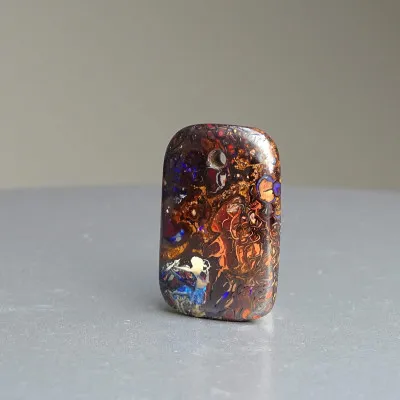
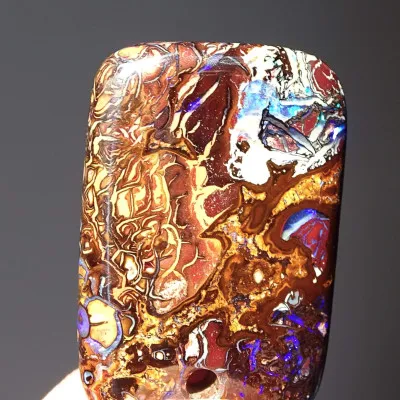
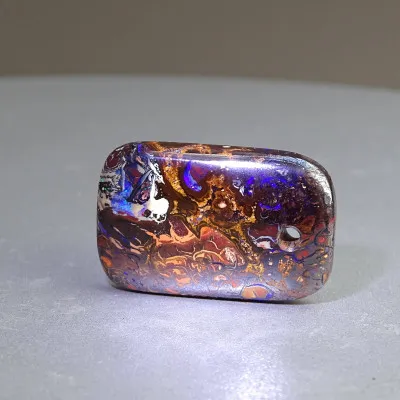
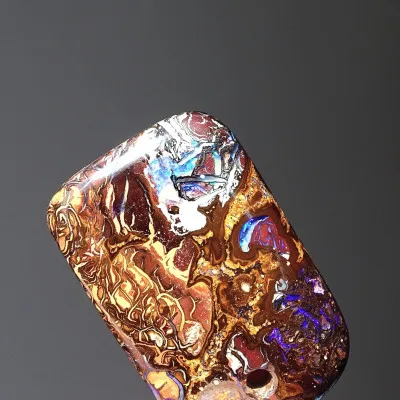
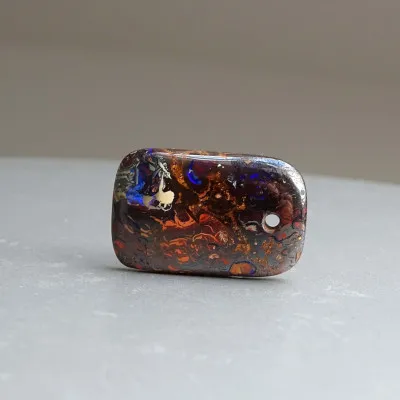
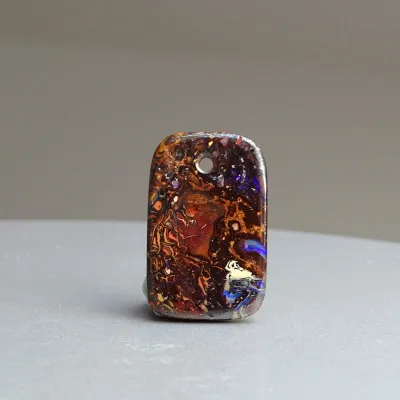
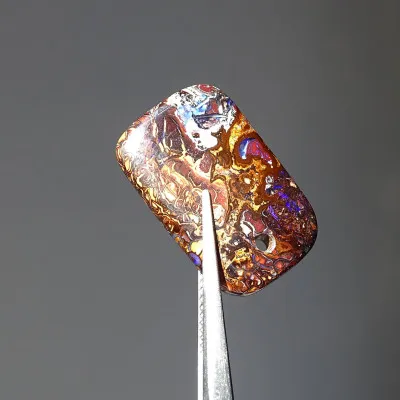
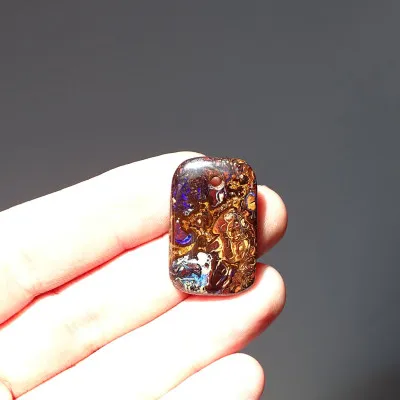
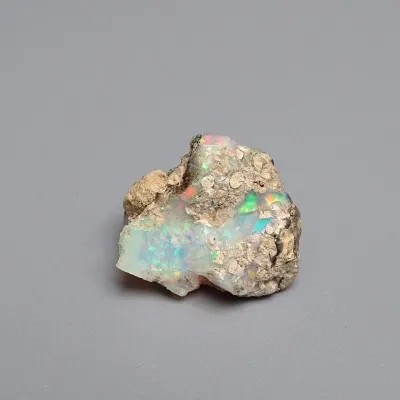
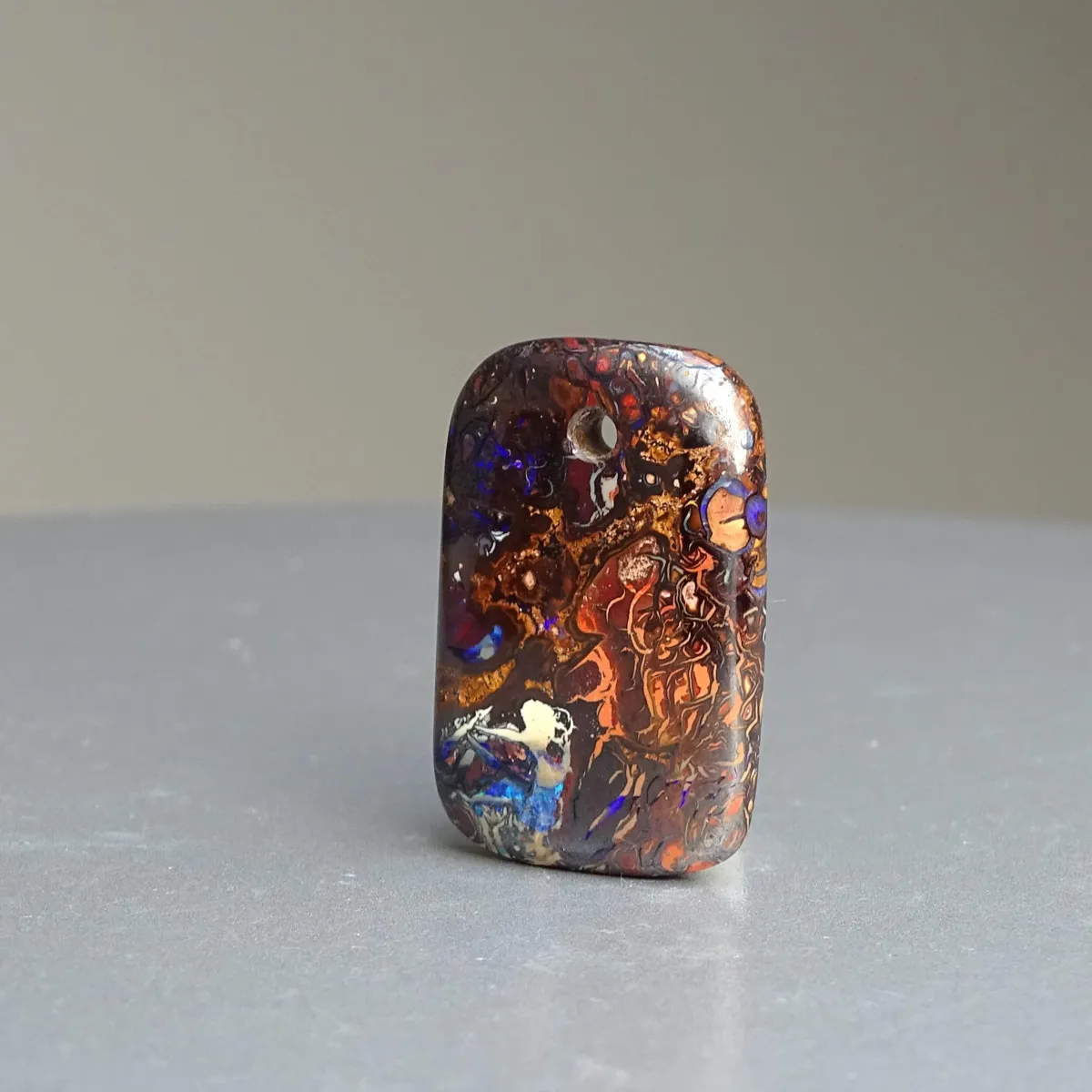
Attractive natural Australian boulder opal in polished shape with a drilled hole for hanging. The stone combines the typical brownish-red ferruginous parent rock with distinctive flashes of blue, turquoise, green and purple. It is the contrast between the earthy structure of the boulder opal and the vibrant opal pattern that creates a unique natural look that makes each piece original. This Australian opal is suitable as a collector's stone, a luxury pendant or a distinctive jewelry component.
Weight: 5.8 g
Dimensions: 2.78 x 1.77 x 0.48 cm
Color: blue, purple
Country of origin: Australia, location: Queensland
You always buy the natural mineral shown in the photo!
Australian opal is one of the most famous and sought-after opals in the world. It is valued above all for its play-of-color – an optical effect in which flashes of green, blue, yellow, orange, red, violet or multicolored light appear inside the stone. Australia is historically the most important source of precious opal and has given the world famous types such as black opal from Lightning Ridge, light opal from Coober Pedy and boulder opal from Queensland.
Australian opal is natural opal originating from Australia. Chemically, it is hydrated silicon dioxide, usually written as SiO2 · nH2O. Unlike quartz, opal does not have a regular crystal structure, which is why it is often described as a mineraloid.
The most valuable Australian opals show strong play-of-color, high brightness, attractive patterns, good transparency or beautiful contrast against a dark body tone. Value is not determined only by size, but mainly by the quality of the color effect, opal type, origin, condition, cut and absence of cracks.
Note: the table is horizontally scrollable on mobile devices so it remains readable and does not collapse into narrow columns.
| Property | Data | Meaning for buyers |
|---|---|---|
| Name | Australian opal | Refers to natural opal originating from Australian opal fields. |
| Chemical composition | SiO2 · nH2O | Hydrated silicon dioxide; natural water content is important for opal stability. |
| Structure | Amorphous, without a classical crystal system | Opal is not a crystal like quartz or topaz; its beauty comes from its microscopic internal structure. |
| Hardness | Approximately 5.5–6.5 on the Mohs scale | Softer than quartz and therefore requires more careful wearing and storage. |
| Optical effect | Play-of-color, opalescence, translucent to opaque appearance | The most important value-forming feature of precious opal. |
| Typical flash colors | Green, blue, yellow, orange, red, violet and multicolored spectral flashes | Red and multicolored flashes on a dark body tone are especially prized. |
| Stability | Sensitive to sudden temperature changes, extreme dryness, chemicals and impact | Proper care is important for long-term beauty and preservation of the stone. |
Australian opal is not a single stone type. Several important commercial and collector forms are distinguished according to body tone, structure, transparency and host rock.
| Opal type | Characteristics | Known areas |
|---|---|---|
| Black opal | A dark to black body tone enhances the intensity of the play-of-color. | Lightning Ridge, New South Wales. |
| Light / white opal | White, cream or light body tone with subtle to vivid play-of-color. | Coober Pedy, Andamooka, Mintabie. |
| Crystal opal | Transparent to translucent opal with color flashes inside the material. | Various Australian regions depending on the specific type. |
| Boulder opal | Opal naturally attached to ironstone host rock, often with a very contrasting appearance. | Queensland, including Winton, Quilpie, Yowah and Koroit. |
| Matrix opal | Opal fills pores, veins or structures within the host rock. | Queensland, Andamooka and other areas depending on the host rock type. |
| Common opal | Opal without strong play-of-color, but often with pleasant color or structure. | Many Australian and worldwide localities. |
Lightning Ridge is the most famous area for black opal. The dark body tone can create exceptional contrast with color flashes, which is why fine black opals from this region rank among the most valuable opals in the world.
Coober Pedy in South Australia is an iconic area for light and white opal. Many stones from this region have a pale body tone with subtle to lively play-of-color. Coober Pedy is one of Australia’s historically most important opal centers.
Andamooka is known for light opals, matrix opals and stones with variable structure. Mintabie is another important South Australian field, associated mainly with light and crystal opals.
Queensland is the home of boulder opal. Areas such as Winton, Quilpie, Yowah and Koroit produce opals naturally connected with ironstone, often showing a beautiful contrast between brown host rock and colorful opal veins.
The value of Australian opal is created by a combination of several factors. The most important are intensity of play-of-color, brightness, contrast, color range, pattern, size, cut, opal type, stability and overall condition of the stone.
Strong red, orange and multicolored flashes are especially valued, particularly on a dark body tone. The pattern of play-of-color is also important – for example broad color patches, mosaic-like structures, harlequin effect, rolling flash or strong directional flashes.
Every opal should also be checked for cracks, stability, possible treatments, thickness of the opal layer, symmetry of the cut and whether it is a solid opal, doublet or triplet. A solid natural opal without glued layers has a different value than a composite stone.
Solid opal is one continuous natural piece of opal without glued layers. In high-quality stones, this is the most valued form.
Opal doublet is a composite stone in which a thin layer of opal is glued onto a dark backing. It can be visually attractive, but its value and care differ from solid opal.
Opal triplet has a thin opal layer between a dark backing and a protective top layer, often made of quartz, glass or another material. When selling opal, it should always be clearly stated whether the stone is solid opal, doublet or triplet.
Opal requires gentle handling. Ultrasonic cleaning, steam, aggressive chemicals, sudden temperature changes, long-term extreme dryness and hard impacts are not recommended. Opal is softer than quartz and may scratch or crack.
Opal jewelry should be removed during sports, chemical work, cleaning, bathing in chlorinated water or any activity where impact may occur. With doublets and triplets, prolonged contact with water should also be avoided because they are glued constructions.
For normal care, a soft cloth and very gentle wiping are sufficient. For valuable opals, expert assessment is better than home cleaning experiments.
Australian opal is natural opal from Australia. The best-known types are black opal from Lightning Ridge, light opal from Coober Pedy and boulder opal from Queensland.
Opal is hydrated silicon dioxide with the formula SiO2 · nH2O. It contains water and does not have a classical crystal structure.
Play-of-color is caused by light scattering within the microscopic internal structure of opal. Different colors and patterns appear depending on the arrangement and size of the particles.
High-quality black opal from Lightning Ridge with intense, bright and multicolored play-of-color is generally among the most valuable opals. The price, however, always depends on the individual stone.
Yes. Boulder opal is natural opal that remains attached to its ironstone host rock. This natural contrast often creates its typical appearance.
Protect it from impact, scratching, ultrasonic cleaning, steam, aggressive chemicals, extreme dryness and sudden temperature changes. Clean only with a soft cloth.
The MINERALS-STONES® project specializes in natural minerals, crystals, druses, tektites, gemstone materials and investment gemstones. With opals, we focus on origin, type, play-of-color, brightness, condition, cut, stability and the real appearance of each individual piece.
Australian opal is a gemstone where light, detail and personal choice matter. For individually listed stones, the customer usually buys the exact stone shown in the photographs. Every opal is unique – two natural Australian opals never look exactly the same.
Attractive natural Australian boulder opal in polished shape with a drilled hole for hanging. The stone combines the typical brownish-red ferruginous parent rock with distinctive flashes of blue, turquoise, green and purple. It is the contrast between the earthy structure of the boulder opal and the vibrant opal pattern that creates a unique natural look that makes each piece original. This Australian opal is suitable as a collector's stone, a luxury pendant or a distinctive jewelry component.
Weight: 5.8 g
Dimensions: 2.78 x 1.77 x 0.48 cm
Color: blue, purple
Country of origin: Australia, location: Queensland
You always buy the natural mineral shown in the photo!