Tanzanite – Rare Blue-Violet Gemstone from Tanzania | MINERALS-STONES®
Tanzanite – Rare Blue-Violet Gemstone from Tanzania
Tanzanite is an exceptional gemstone found in only one place on Earth — northern Tanzania. Although discovered in modern times, it quickly achieved status as a highly desirable collector and investment gemstone thanks to its color, rarity and single-source origin. Mineralogically, tanzanite is a blue-to-violet variety of the mineral zoisite.
Basic identification of tanzanite
Mineralogical classification
- Mineral: zoisite
- Chemical formula: Ca₂Al₃(SiO₄)₃(OH)
- Crystal system: orthorhombic
- Hardness (Mohs): 6–6.5
- Density: approx. 3.35 g/cm³
- Optical features: strong pleochroism
Locality and origin
The only confirmed deposit worldwide
Tanzanite is mined exclusively in the Merelani Hills in northern Tanzania, within a narrow belt roughly 20 km long and only a few kilometers wide. No confirmed deposits exist outside Tanzania.
Why it doesn’t occur elsewhere
Tanzanite formation requires an unusually specific set of geological conditions — metamorphism of calcium- and aluminum-rich rocks combined with trace amounts of vanadium. This unique combination has not been replicated elsewhere.
How tanzanite forms in nature
Tanzanite formed about 585 million years ago through metamorphic processes under high pressure and temperature. Trace vanadium plays a key role in producing its characteristic blue-violet coloration.
Color, pleochroism and optical properties
Typical color range
The most valuable tanzanites display a rich blue to blue-violet color. Lower grades may show grayish or brownish components.
Pleochroism
Tanzanite is famous for strong pleochroism — depending on viewing direction, it can show blue, violet and sometimes brownish tones. Proper cutting optimizes this optical behavior.
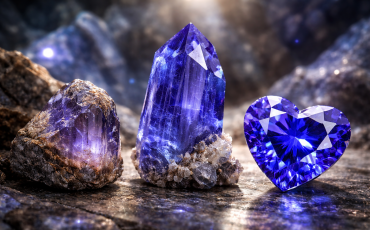
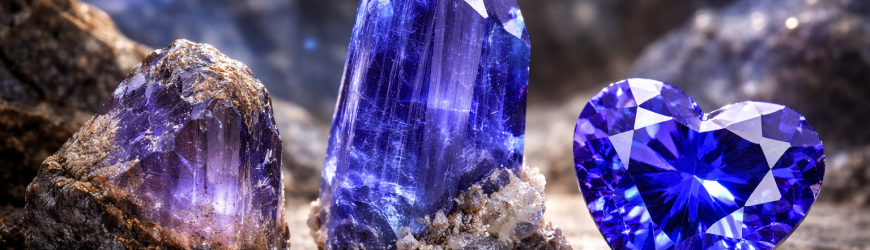
Rough tanzanite crystals
Rough tanzanite crystals often appear brownish to greenish before processing. Natural crystals in collector condition are highly prized, especially when well-formed and sourced from historically known mining zones.
Faceted tanzanite as a gemstone
Why tanzanite is cut
Faceting enhances visual performance by intensifying perceived color and highlighting pleochroism. Faceted stones are used in fine jewelry and are also sought after by collectors and investors.
Common cuts
- Oval
- Cushion
- Emerald cut
- Pear
Heat treatment of tanzanite
Is heating normal for tanzanite?
Yes. Heat treatment at approximately 500–600 °C is common and widely accepted for tanzanite. It removes brownish tones and strengthens the desired blue-violet color.
What is acceptable — and what is not
- Heat treatment: common and accepted
- Dyeing: not acceptable
- Synthetic tanzanite: does not exist
How tanzanite quality is evaluated
Color (the most important factor)
Color is the main value driver. Top quality is often labeled AAA in the trade (terminology can vary by seller).
Clarity
High-quality tanzanite is commonly eye-clean. Minor inclusions can still occur in natural stones.
Size (carat weight)
Stones above 5 ct are significantly rarer and are often considered more investment-relevant.
Investment potential of tanzanite
A single-source deposit, limited reserves and steady global demand make tanzanite a gemstone closely watched from an investment perspective — especially in top color, good clarity and larger sizes.
How to choose a genuine tanzanite
- Ask for clear origin information (Tanzania / Merelani)
- Confirm disclosed treatments (heating is normal)
- Check color under different lighting conditions
- Buy from reputable, transparent sellers
History, legends and interesting facts
Tanzanite was discovered in 1967 and rapidly became a modern gemstone icon. In local storytelling (including the Maasai), it is sometimes associated with change and good fortune.
Tanzanite and “energy work”
Some people associate tanzanite with meditation and inner transformation. These interpretations are subjective and should not be presented as physically measurable effects.
Expert context
Expert context:
To understand the broader context of minerals and gemstones – formation, properties, collecting and investment aspects, as well as natural resonance topics – we recommend our expert guide to minerals and gemstones.
https://minerals-stones.com/en/3-natural-minerals-gemstones-crystals-druises