
Schumann Resonance: Earth Frequency, Minerals and Vibrations | MINERALS-STONES
MINERALS-STONES® • Schumann Resonance • Earth Frequency • Minerals
Schumann Resonance: the frequency of the Earth and the real connection with minerals
Schumann resonance is one of the most fascinating natural phenomena at the intersection of atmospheric physics, electromagnetism and the understanding of Earth as a dynamic system. It is often called the “frequency of the Earth”. More precisely, however, it should be understood as a set of electromagnetic resonances in the space between the Earth’s surface and the ionosphere. This article explains how Schumann resonance forms, how it is measured, how the data evolve and what the real physical connection is between frequencies, crystals and minerals.
Core idea
Earth has measurable electromagnetic resonances. Minerals have their own crystalline, mechanical and vibrational properties. The connection is physical — not cheap mysticism.
Quick answer: what is Schumann resonance?
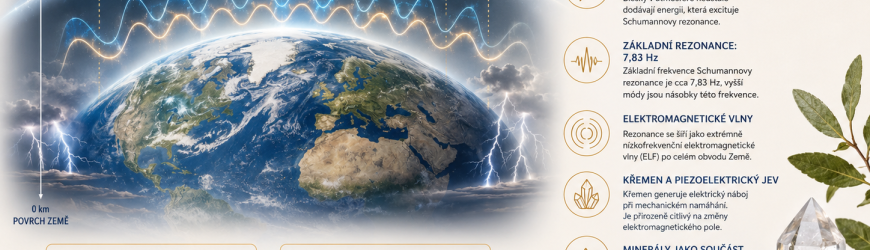
Schumann resonance is a natural electromagnetic resonance phenomenon in the space between the Earth’s surface and the ionosphere. This region behaves like a vast resonant cavity. Global lightning activity continuously feeds electromagnetic energy into this system, producing standing waves in the extremely low frequency ELF range. The best-known fundamental mode is approximately 7.83 Hz, while higher resonance modes appear around 14, 20, 26 Hz and above. However, this is not a mechanical vibration of the entire Earth as a solid rocky body, but an electromagnetic phenomenon of the Earth–ionosphere system.
Earth–ionosphere
Schumann resonance forms in the electromagnetic cavity between the Earth’s surface and the ionosphere. This space allows extremely long ELF waves to propagate around the planet.
Lightning as the source
The main natural source of energy is lightning discharge. Thunderstorm activity occurs continuously around the globe and repeatedly excites the resonant system.
Frequency around 7.83 Hz
The well-known value of 7.83 Hz refers to the fundamental mode. In practice, it can shift slightly depending on the ionosphere, time of day, thunderstorm activity and solar activity.
Data measurement
It is measured using low-frequency magnetic and electric sensors. The result is not merely a line on a graph, but a spectral image of global electromagnetic activity.
Minerals vibrate differently
Minerals have atomic, crystalline and sometimes piezoelectric properties. Their vibrations are measured by different methods than Schumann resonance.
No empty promises
The connection between Earth, frequencies and minerals is fascinating. Still, physics, symbolism, meditation and unsupported health claims must remain clearly separated.
Why is Schumann resonance called the frequency of the Earth?
The expression “frequency of the Earth” is popular, understandable and poetic. From a scientific perspective, however, it is important to clarify what it really means. Schumann resonance is not the heartbeat of the planet in a biological sense, nor is it a mechanical rumble from the Earth’s interior. It is a global electromagnetic resonance system formed between the conductive Earth’s surface and the ionosphere.
The Earth’s surface and the ionosphere form the boundaries of a vast spherical resonant cavity. Electromagnetic impulses from lightning spread through this space around the planet. Because the circumference of the Earth and the properties of the ionosphere determine which wavelengths can be sustained most effectively, resonance modes arise. The best-known fundamental mode is around 7.83 Hz.
This is the true core of the idea: Earth is not a passive object. It is a dynamic system with an atmosphere, magnetosphere, ionosphere, thunderstorms, electric fields, seismic activity, oceans, minerals and crystalline rocks. When we say in popular language that “Earth vibrates”, we should add that there are several types of such vibrations: electromagnetic, mechanical, seismic, acoustic and crystalline.
Schumann resonance is an electromagnetic phenomenon. Minerals have their own vibrational modes in the crystal lattice, mechanical resonances depending on shape and, in some minerals, piezoelectric properties. It is therefore not correct to say that all minerals automatically vibrate at 7.83 Hz. A more accurate statement is that minerals are part of the dynamic physical system of Earth.
Basic data of Schumann resonance
In measurement charts, Schumann resonance usually does not appear as one perfectly fixed line. It is a set of resonance peaks in the ELF spectrum. The position and intensity of these peaks can change depending on ionospheric conditions, time of day, global thunderstorm activity, season and other factors.
| Resonance mode | Approximate frequency | Meaning |
|---|---|---|
| First mode | around 7.8 Hz | The best-known fundamental frequency of Schumann resonance. |
| Second mode | around 14 Hz | A higher resonance mode of the global Earth–ionosphere cavity. |
| Third mode | around 20 Hz | Another spectral peak observed in ELF measurements. |
| Fourth mode | around 26 Hz | A higher mode sensitive to propagation conditions inside the cavity. |
| Higher modes | approximately 30+ Hz | Weaker and less stable spectral features depending on measurement and conditions. |
These values are not absolutely identical every second and at every measuring location. Scientific data examine frequency peaks, intensity, bandwidth, daily changes, seasonal development, thunderstorm sources and ionospheric responses.
How does Schumann resonance form?
Schumann resonance forms through the combination of three main factors: the conductive Earth’s surface, the conductive ionosphere and continuous global lightning activity. Every lightning strike is a powerful electrical discharge. Part of its energy propagates as electromagnetic waves in the extremely low frequency range.
These waves can travel through the space between Earth and the ionosphere. Because this is a spherical cavity with limited dimensions, certain frequencies are sustained more efficiently than others. Similar to the way a musical instrument emphasizes its own natural tones, the Earth–ionosphere system amplifies its own resonance modes.
However, this is not music in the ordinary sense. The frequency around 7.83 Hz is not a normal audible tone propagating through air. It is an electromagnetic oscillation in the ELF range that is detected by specialized instruments.
1. Lightning
A lightning discharge creates an electromagnetic impulse containing a broad range of frequencies, including an ELF component.
2. Cavity
The space between the Earth’s surface and the ionosphere behaves like a vast waveguide and resonance chamber.
3. Resonance
Certain frequencies are amplified and form spectral peaks known as Schumann resonances.
Myth versus reality
Does 7.83 Hz mean that all minerals vibrate in the same way?
No. This is a common oversimplification. Schumann resonance is an electromagnetic resonance of the Earth–ionosphere system. Minerals have their own vibrational properties determined by atomic structure, chemical bonds, crystal lattice, the shape of the specific specimen and physical parameters.
A more accurate view is this: if Earth creates an electromagnetic, seismic and geological environment, minerals are part of that system. Minerals do indeed vibrate at atomic and crystalline levels, but those vibrations are measured by different methods and are not automatically identical to Schumann resonance.
What is the real connection?
- minerals are part of the Earth’s crust,
- crystals have lattice vibrations,
- quartz exhibits the piezoelectric effect,
- some minerals respond to light, pressure or electric fields,
- vibrations can be measured in laboratories,
- symbolic meaning is not the same as a medical claim.
How is Schumann resonance measured?
Measuring Schumann resonance is technically demanding because it involves very weak signals in the extremely low frequency range. Sensitive magnetic antennas, induction coils, magnetometers or electric sensors are used to detect low-frequency changes in the electromagnetic field.
The measured signal is usually transformed into a spectrum using mathematical analysis. The result is a graph where resonance peaks can be observed. The measuring station must be well protected from interference: power lines, industry, urban infrastructure, railways or local electronics can significantly distort the data.
Serious measurement therefore means more than displaying a colorful online chart. Scientifically, it is necessary to know what sensor was used, where the station is located, how noise is filtered, how the spectrum is calculated and how global signal is separated from local interference.
| Measuring element | What it observes | Why it matters |
|---|---|---|
| Magnetic antenna / induction coil | Low-frequency magnetic field components | Allows weak ELF signals related to Schumann resonance to be detected. |
| Electric antenna | Vertical electric field component | Complements magnetic measurements and allows comparison of different field components. |
| Spectral analysis | Decomposition of the signal by frequency | Shows where resonance peaks lie and how their intensity changes. |
| Time series | Signal development over time | Helps analyze daily cycles, thunderstorm activity and ionospheric changes. |
| Low-interference location | Minimization of local noise | Without a suitable location, natural signal cannot be reliably separated from technical interference. |
Data development: why do Schumann resonance charts fluctuate?
In public discussion, colorful Schumann resonance charts are often interpreted dramatically. Sometimes it is claimed that the “frequency of the Earth is rising sharply” or that the planet is “moving into higher vibrations”. From a scientific perspective, caution is necessary.
In Schumann resonance data, what changes over time most often are amplitude, width and clarity of spectral peaks. The fundamental frequency around 7.8 Hz can shift slightly, but the most visually dramatic changes in charts are often changes in signal intensity, interference, thunderstorm activity or ionospheric conditions — not automatic proof that the entire planet has “retuned” to a completely different frequency.
The day and night sides of Earth also matter. The ionosphere changes according to solar radiation. Thunderstorm regions shift between Africa, South America, Southeast Asia and the oceans. A local measuring station therefore always detects a combination of global signal, the direction of thunderstorm activity and local measuring conditions.
What changes naturally in the data?
- signal amplitude,
- intensity of individual modes,
- width of resonance peaks,
- daily and seasonal patterns,
- influence of global thunderstorms,
- ionospheric conditions.
What should you be careful about?
- do not confuse amplitude with frequency,
- do not draw spiritual conclusions from a single chart,
- verify the data source,
- check the measuring method,
- allow for local interference,
- separate science, symbolism and interpretation.
If Earth vibrates, do minerals vibrate too?
This is a very good question because it connects the poetic idea of Earth as a living system with the real physics of minerals. The answer is: yes, minerals have their own vibrations — but we must define exactly what kind of vibration we mean.
At the atomic level, atoms in a crystal lattice are constantly moving. These motions are related to thermal energy, chemical bonds, atomic mass and crystal structure. In solid-state physics, these collective vibrations are described as phonons. This is precisely why minerals can be studied using vibrational spectroscopic methods.
At the macroscopic level, a specific mineral specimen or crystal can also vibrate mechanically. Its mechanical resonance depends on shape, size, density, elasticity, cracks and how it is held. A large rock crystal, a polished aquamarine, an amethyst druse and a faceted tanzanite will not resonate in the same way.
Quartz has a special position. Due to the piezoelectric effect, it can convert mechanical stress into an electrical signal and vice versa. This is why quartz crystals are used in oscillators, watches and precise frequency devices. We explore this topic more deeply in the article Silicon and quartz: the foundation of the planet and technology.
How can the vibrations of minerals be measured?
Scientific measurement of “mineral vibrations” does not work by placing a universal device next to a stone and receiving one spiritual frequency. Minerals are measured according to a specific physical question. Different methods are used for atomic vibrations, chemical bonds, mechanical resonance and piezoelectric response.
| Method | What it measures | Use with minerals |
|---|---|---|
| Raman spectroscopy | Vibrational modes of the crystal lattice and chemical bonds | Identification of minerals, gemstones, pigments, inclusions and synthetic materials. |
| FTIR spectroscopy | Infrared absorption caused by bond vibrations | Recognition of mineral groups, water, OH groups, organic fillers or certain treatments. |
| Piezoelectric measurement | Electrical response to mechanical stress and vice versa | Typical for quartz and piezoelectric materials; foundation of quartz oscillators. |
| Acoustic or mechanical resonance | Macroscopic vibration of a specific specimen | Depends on the specimen’s shape, size, elasticity, density and internal cracks. |
| Optical spectroscopy | Absorption, transmission, luminescence or UV response | Helps determine color, trace elements, fluorescence and certain treatment types. |
| X-ray diffraction | Crystal structure, not directly “vibration” | Confirmation of mineral phase, crystal system and structure. |
When we speak professionally about mineral vibrations, we mean measurable physical phenomena. The crystal lattice has vibrational modes. Molecular and ionic bonds have characteristic absorption bands. Quartz can mechanically resonate and, thanks to piezoelectricity, stabilize frequencies in electronic circuits. This is the real and measurable connection between minerals, frequencies and technology.
Quartz as a bridge between minerals and frequency
Quartz is the best example of a mineral where the connection between crystal structure and frequency has become part of practical technology. In quartz oscillators, the piezoelectric effect is used: an electrical voltage sets the crystal into vibration, and its mechanical resonance helps generate a highly stable frequency.
This principle is behind quartz watches, timing circuits, electronics, measuring devices and many sensors. It is not an esoteric slogan but practical solid-state physics. Quartz shows that minerals can genuinely carry precise frequency behavior when they have the right properties, shape, cut and circuit integration.
This is where the statement “minerals and frequencies are connected” can be true if it is explained correctly. It does not mean that every stone heals or automatically operates on one universal frequency. It means that crystals are ordered structures of matter with measurable vibrational, optical, electrical and mechanical properties.
Schumann resonance, human perception and meditation
Schumann resonance fascinates many people also because its fundamental frequency around 7.83 Hz lies in a range that popular literature often compares with low-frequency brain rhythms. This comparison is interesting, but it must remain precise: similarity of frequency range alone does not prove a direct healing effect.
For meditation, relaxation or perception of nature, however, Schumann resonance can serve as a strong symbolic inspiration. A person realizes that they are not separated from the environment. They live within the electromagnetic, geological and biological system of Earth. Minerals held in the hand or placed in a space can function on this level as an anchor of attention, an aesthetic object, a symbol of stability, natural beauty and connection to the landscape.
At MINERALS-STONES®, we therefore distinguish two levels: the scientific and the symbolic. Scientifically, we speak about mineralogy, spectroscopy, crystal structure and measurable phenomena. Symbolically, we may speak about calm, focus, meditation, space and a personal relationship with a stone. These levels can complement one another, but they should not be confused with medical claims.
A broader view of frequencies, crystals and human perception is developed in the articles Frequencies, vibrations and minerals and Sound, vibrations and crystals.
Cymatics: when vibration becomes visible form
Cymatics shows that mechanical vibrations can create visible patterns in matter. When a plate, membrane, liquid or fine powder is excited by a specific frequency, geometric structures can appear along the nodes and antinodes of standing waves.
This phenomenon is a beautiful bridge between physics and aesthetics. It shows that vibration is not merely an abstract number. It can organize matter into forms, patterns and structures. However, this does not mean that every visually beautiful mineral was created by the action of one simple sound frequency. Minerals form geologically: by crystallization, pressure, temperature, chemical reactions, metamorphism, sedimentation or hydrothermal processes.
More about cymatics can be found on the specialized portal Energie Frekvence Vibrace – Cymatics: how sound creates geometry.
Minerals as the memory of geological processes
A mineral is not an empty decorative object. It is a crystalline or mineral form of matter that formed in a specific environment. It carries information about pressure, temperature, chemical composition, fluids, fractures, trace elements, crystal growth and sometimes even dramatic geological events.
When we look at aquamarine, we see beryl from an environment where pegmatites, beryllium and crystallization conditions played a role. With hemimorphite, we enter the world of secondary zinc minerals and oxidized deposit zones. In tanzanite, the story is one of metamorphism and an exceptionally limited origin in Tanzania. alexandrite fascinates through color change related to optical absorption and trace elements.
Every mineral therefore contains “information”, but not in the sense of a magical record. It is geological, chemical, optical and structural information that can be studied. This is the real depth of minerals: they are beautiful and, at the same time, scientifically readable.
MINERALS-STONES® recommends
Frequencies, vibrations and minerals make sense when connected with expertise
Schumann resonance shows that Earth has a measurable electromagnetic rhythm. Minerals show that matter has crystal structure, vibrational modes, optical responses and, in some cases, piezoelectric properties. The greatest value of this topic emerges when we move beyond superficial slogans and connect physics, mineralogy, geology, symbolism and real measurement.
As with UV minerals and fluorescence, natural phenomena are most beautiful when we understand them. Fluorescence is not magic, but an optical response. The piezoelectricity of quartz is not magic, but physics. Schumann resonance is not a myth, but an electromagnetic reality of Earth.
Schumann resonance and gemstones: where is the real value?
The topic of frequencies and minerals can be inspiring, but it must never replace professional evaluation when dealing with valuable gemstones. If you are choosing tanzanite, sapphire, emerald, alexandrite or another gemstone, its value does not come from a claim about “vibration”, but from the quality of the specific stone.
For gemstones, color, clarity, cut, size, origin, possible treatments and documentation are decisive. This is why MINERALS-STONES® also focuses on topics such as investment gemstones and gemstone certification in Europe.
Frequencies, resonance and symbolism can enrich the personal relationship with a stone. They should not, however, replace mineralogy, gemology and transparency. That is the difference between meaningful depth and empty marketing.
How can we imagine the frequency of Earth in practice?
Imagine Earth as a multilayered system. Lightning forms in the atmosphere. Electromagnetic waves propagate between the surface and the ionosphere. Rocks and minerals exist in the Earth’s crust. They form and transform through geological processes. Atomic vibrations exist within crystals. Some minerals respond to light, others to pressure and others to electric fields.
The real connection is therefore not the simple sentence “a stone vibrates at the frequency of Earth”. The real connection is much more beautiful: the planet is a physical whole where electromagnetic fields, geology, crystallography, optics, pressure, temperature, time and human perception meet.
This is why the topic of Schumann resonance has its place on the MINERALS-STONES® blog. Not as a miraculous promise, but as a scientifically grounded popular bridge between Earth, frequencies, crystals and a conscious relationship with nature.
The most common misconceptions about Schumann resonance
Myth 1: Schumann resonance is exactly 7.83 Hz and never changes
The fundamental mode is often given as about 7.83 Hz, but real data show slight shifts and changes depending on the ionosphere, time of day, solar activity and thunderstorm conditions.
Myth 2: When a chart becomes stronger, Earth has increased its frequency
A bright or strong chart display often means a change in amplitude or signal intensity, not automatically a change in the planet’s fundamental frequency.
Myth 3: All minerals vibrate at 7.83 Hz
Minerals have their own vibrational modes determined by crystal structure, chemical bonds, shape and physical properties. There is no single universal frequency for all minerals.
Myth 4: A mineral’s frequency proves a healing effect
Measurable vibrational properties of minerals are physical reality, but not automatic proof of a health effect. Symbolic, meditative and aesthetic use must be separated from medical claims.
Checklist: how to read information about mineral frequencies sensibly
What to look for
- whether electromagnetic and mechanical vibration are distinguished,
- whether a measurement method is stated,
- whether frequency and amplitude are not confused,
- whether expert sources are used,
- whether no healing promises are made,
- whether physics and symbolism remain separate.
What is suspicious
- claims that every stone has one “healing frequency”,
- charts without a source and measuring method,
- confusing Schumann resonance with audible sound,
- health promises based on a stone,
- overinterpreting every fluctuation in data,
- sales texts without mineralogy and physics.
Related articles and internal links
For deeper understanding, we recommend continuing with other articles and categories within the MINERALS-STONES® ecosystem and related specialist portals:
- Frequencies, vibrations and minerals: crystal physics and human perception
- Sound, vibrations and crystals: when frequencies become form
- Silicon and quartz: the foundation of the planet and technology
- UV minerals and fluorescence: which stones glow under UV light
- Investment gemstones: tanzanite, sapphire, Padparadscha sapphire and emerald
- Gemstone certification in Europe
- Tanzanite blog – Tanzanite Academy
- Alchemy of sacred stones – the symbolic level of stones
Scientific sources and data
ELF Electromagnetic Waves from Lightning: The Schumann Resonances
NIPR DATA BASE – 1–100 Hz ULF/ELF Electromagnetic Wave Observation Data
Radio Science – Reconstruction of Global Lightning Activity Based on Schumann Resonance Measurements
NIST – Quartz Crystal Microbalances and Piezoelectric Quartz
NIST – Time and Frequency, Quartz Crystal Oscillators
USGS Spectral Library Version 7
University of Hamburg – Raman Spectroscopy and Vibrational Information
University of Hamburg – Vibrational Spectroscopies: Raman and FTIR
FAQ: frequently asked questions about Schumann resonance and minerals
What is Schumann resonance?
Schumann resonance is a set of natural electromagnetic resonances in the cavity between the Earth’s surface and the ionosphere. It is mainly excited by global lightning activity.
Is the fundamental frequency really 7.83 Hz?
The fundamental mode is usually stated as approximately 7.83 Hz. In real data, however, it may shift slightly depending on the ionosphere, time of day and thunderstorm activity.
How is Schumann resonance measured?
It is measured using sensitive low-frequency magnetic and electric sensors. The data are then evaluated through spectral analysis in the ELF range.
Do strong or bright areas in charts mean that Earth’s frequency has changed?
Not necessarily. They often indicate a change in amplitude, signal intensity, interference or thunderstorm activity. Frequency and amplitude must be clearly distinguished.
Do minerals vibrate?
Yes, minerals have atomic and crystalline vibrations. These are measured by methods different from Schumann resonance, such as Raman or FTIR spectroscopy.
Do all minerals have one universal frequency?
No. Each mineral has properties determined by structure, composition, bonds and the specific physical form of the specimen. There is no universal frequency for all minerals.
Why is quartz important in frequency technologies?
Quartz has piezoelectric properties. When properly cut and integrated into an electrical circuit, it can function as a stable resonator, for example in watches and oscillators.
Can mineral vibrations be measured scientifically?
Yes. Methods include Raman spectroscopy, FTIR infrared spectroscopy, acoustic resonance, piezoelectric measurements and optical spectroscopy.
Does Schumann resonance have a healing effect?
Schumann resonance is a real physical phenomenon. Direct healing effects, however, cannot be claimed without strong scientific evidence. MINERALS-STONES® distinguishes physics, symbolism, meditation and health claims.
What is the real connection between Schumann resonance and minerals?
The real connection is that minerals are part of dynamic Earth and have measurable crystalline, optical, mechanical or electrical properties. It is not correct to claim that all minerals automatically resonate at 7.83 Hz.
MINERALS-STONES®
MINERALS-STONES® connects the beauty of natural minerals, gemstones and crystals with expert explanations of their origin, structure, optical properties and true value. The world of frequencies, vibrations and stones is most fascinating when it is grounded in mineralogy, physics and transparent information.