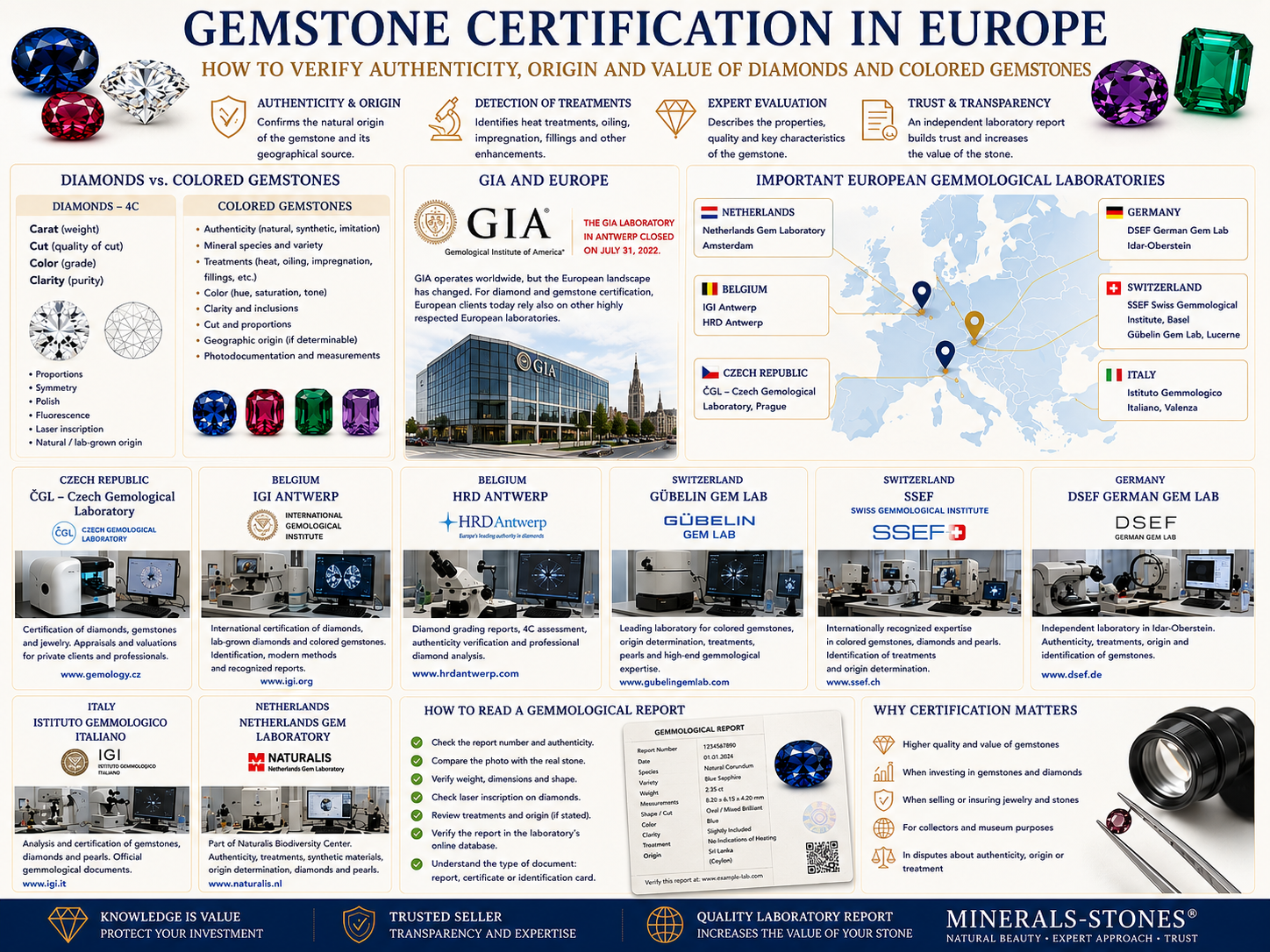
Gemstone Certification in Europe: GIA, ČGL, IGI, HRD, SSEF and Gübelin | MINERALS-STONES

Gemstone Certification in Europe: How to Verify the Authenticity, Origin and Value of a Diamond, Sapphire, Emerald or Tanzanite
When evaluating natural gemstones, beauty, color or size alone are not enough. Two stones may look very similar at first glance, yet their real value can differ significantly. The decisive question is whether the stone is natural, synthetic, an imitation, a laboratory-grown diamond, a heat-treated sapphire, an oiled emerald or, for example, a ruby with filled fractures.
This is why gemstone and diamond certification plays such an important role in modern gemology. A laboratory report helps verify the identity of the stone, its basic properties, possible treatments and, in the case of some significant colored gemstones, also the probable geographic origin. For customers, collectors and investors, a certificate is an important tool of transparency.
At MINERALS-STONES® we place long-term emphasis on expert description, natural origin, quality, transparency and, for higher-value gemstones, the importance of independent laboratory verification. This article explains when certification makes sense, how diamond certification differs from colored gemstone certification and which European laboratories are among the important institutions in the field today.
Why gemstone certification is important
A gemstone is not an ordinary mass-produced product. Every natural stone has its own origin, geological history, inclusions, color, cut and possible treatments. For higher-value stones, a simple trade description is not sufficient. The customer should know what stone they are buying and whether the stated parameters truly correspond to the specific stone.
Certification helps answer several key questions:
- Is the stone natural, synthetic or an imitation?
- What is the mineral species and trade variety?
- Were any treatments detected, such as heating, oiling, impregnation or fillings?
- Do the weight, dimensions and photograph match the specific stone?
- Can the probable geographic origin be determined for this gemstone?
- Is the stone suitable as a collector’s specimen or an investment-relevant gemstone?
A certificate by itself is not a guarantee of future appreciation. It is an expert document that describes the properties of the stone. The commercial value then depends on quality, rarity, origin, demand, condition of the stone and the credibility of the seller.
Diamonds and colored gemstones: different evaluation methods
Diamond certification is generally more standardized than colored gemstone certification. Diamonds are most often evaluated using the 4C system: carat, cut, color and clarity. Additional parameters include proportions, symmetry, polish, fluorescence, possible treatments and, in some cases, laser inscription.
With colored gemstones, evaluation is broader and often more complex. Sapphire, ruby, emerald, tanzanite, alexandrite, spinel or tourmaline are not assessed by one universal system. Each gemstone has a different mineralogical nature, typical inclusions, color range, common treatments and a different importance of origin.
| Stone type | What is most often verified | Why it matters |
|---|---|---|
| Diamond | 4C, natural/lab-grown origin, fluorescence, proportions, inscription | Influences price, tradability and credibility of the stone |
| Sapphire | Natural origin, heat treatment, color, origin | No-heat sapphires and important localities may have higher value |
| Ruby | Heating, fillings, origin, color | Treatments can significantly change the value of the stone |
| Emerald | Oiling, impregnation, origin, clarity | No-oil or minimally treated pieces are significantly more desirable |
| Tanzanite | Identification of natural zoisite, color, clarity, origin | Tanzanite is connected with one main commercial locality in Tanzania |
| Alexandrite | Authenticity, color change, origin, treatments | A strong color-change effect is essential for value |
GIA and the changing map of certification in Europe
GIA – Gemological Institute of America is one of the best-known gemological institutions in the world. It is associated primarily with diamond grading, education, research and laboratory services. For many customers, GIA is synonymous with a trusted diamond report.
However, the European availability of GIA has changed. The GIA laboratory in Antwerp, Belgium, was closed as of July 31, 2022. Antwerp has long been one of the major centers of the European diamond trade, so the closure of this location was an important change for the European market.
GIA as an institution continues to operate globally and its reports still hold a strong position. For European customers, however, this means that for some stones it may be necessary to send them to other GIA laboratories or to consider one of the respected European alternatives.
Czech Republic: ČGL and domestic gemological expertise
In the Czech environment, the Česká gemologická laboratoř – ČGL, the Czech Gemological Laboratory, plays an important role. For Czech customers, a domestic laboratory can be practical especially for diamonds, colored stones, jewelry, preliminary verification, certification or valuation.
ČGL focuses on the identification and certification of diamonds, gemstones and jewelry. For more common stones or jewelry, domestic expert evaluation may be faster and more economically reasonable than sending the stone abroad.
For exceptionally valuable investment gemstones, however, international reports from specialized global laboratories are often used as well. This depends on the value of the stone, the purpose of certification, the buyer’s requirements and future tradability.
European laboratories worth knowing
Europe still has a strong gemological infrastructure. Alongside the Czech ČGL, important laboratories operate in Belgium, Switzerland, Germany, Italy and the Netherlands. Some are known mainly for diamonds, while others have a very strong position in colored gemstones, origin determination and treatment detection.
| Laboratory | Country | Key specialization | Official source |
|---|---|---|---|
| ČGL – Czech Gemological Laboratory | Czech Republic | Diamonds, gemstones, jewelry, valuations | gemology.cz |
| IGI Antwerp | Belgium | Diamonds, lab-grown diamonds, jewelry, reports | igi.org |
| HRD Antwerp | Belgium | Diamond grading reports, 4C, diamond market | hrdantwerp.com |
| Gübelin Gem Lab | Switzerland | Colored gemstones, origin, treatments, high-level reports | gubelingemlab.com |
| SSEF – Swiss Gemmological Institute | Switzerland | Colored gemstones, diamonds, pearls, origin and treatments | ssef.ch |
| DSEF German Gem Lab | Germany | Gemstone identification, origin, treatment detection | dsef.de |
| CISGEM | Italy | Gemstone analysis, certification, official laboratory documents | cisgem.com |
| Netherlands Gem Laboratory | Netherlands | Authenticity, treatments, synthetic origin, country of origin, diamonds and pearls | naturalis.nl |
Belgium: IGI Antwerp and HRD Antwerp
Belgium, especially Antwerp, remains one of the main European centers of the diamond trade. Even after the closure of the GIA laboratory in Antwerp, important institutions connected with the certification of diamonds, jewelry and other gemological materials continue to operate there.
IGI Antwerp is an important branch of the International Gemological Institute. IGI is known especially for diamond reports, laboratory-grown diamonds and jewelry. For the customer, it is important that the report clearly states whether the diamond is natural or laboratory-grown.
HRD Antwerp is another significant Belgian institution connected with diamond grading. For natural diamonds, it focuses on confirming authenticity and describing the key 4C parameters: carat weight, color, clarity and cut.
Switzerland: Gübelin Gem Lab and SSEF
Switzerland belongs among the most respected European centers for the analysis of colored gemstones. Gübelin Gem Lab and SSEF are among the laboratories whose reports have a strong position especially for important rubies, sapphires, emeralds, alexandrites and other valuable colored stones.
Gübelin Gem Lab is an internationally respected laboratory with a long history of testing exceptional gemstones, diamonds and pearls. For colored gemstones, the assessment of authenticity, treatments and origin may be particularly important.
SSEF – Swiss Gemmological Institute works with colored gemstones, diamonds and pearls. For colored stones, SSEF emphasizes expertise in treatment detection and origin determination, based on long-term research, reference collections and modern analytical methods.
Germany: DSEF German Gem Lab in Idar-Oberstein
DSEF German Gem Lab is based in Idar-Oberstein, a traditional European center of gemstone cutting, trade and research. The laboratory focuses on examining authenticity, detectable treatments and, where possible, the origin of gemstone material.
For the European market, DSEF is important especially for colored gemstones, where an independent report can help distinguish a natural stone from synthetic or treated material.
Italy and the Netherlands: other expert European institutions
Italy has a long tradition of gemological verification thanks to its jewelry and goldsmithing industry. CISGEM offers gemological analysis and certification for private clients and professionals and issues official analytical documents.
In the Netherlands, the Netherlands Gem Laboratory operates as part of the Naturalis Biodiversity Center. The laboratory deals with questions of gemstone authenticity, synthetic or natural origin, imitations, treatments, geographic origin, diamonds and pearls.
How to choose the right laboratory according to stone type
There is no single universal laboratory for every situation. The right choice depends on the type of stone, its value, the purpose of the report and the target market.
For diamonds
For natural diamonds, the grading report is the most important document. The main criteria are 4C, fluorescence, proportions, symmetry, polish and, where applicable, laser inscription. Laboratories such as GIA, IGI or HRD Antwerp are important for international trade.
For laboratory-grown diamonds
For laboratory-grown diamonds, it is essential that the report transparently states that the stone is not a natural diamond. Natural and laboratory-grown diamonds may have similar physical properties, but they differ in origin, market value and investment significance.
For sapphires and rubies
For sapphires and rubies, authenticity, heat treatment, fillings, color and, for more important stones, origin are especially important. A no-heat sapphire or a ruby without significant treatments may have a completely different value than a treated stone of similar appearance.
For emeralds
For emeralds, the degree of oiling or impregnation is essential. Emeralds with minimal treatment or without oiling are significantly more valued in top-quality pieces. Certification helps clarify what type of treatment was detected.
For tanzanite, alexandrite and spinel
For tanzanite, it is important to confirm that the stone is natural zoisite – the tanzanite variety. For alexandrite, authenticity and the intensity of the color change are crucial. For spinel, natural origin, color, clarity and the absence of misleading trade descriptions are monitored.
For jewelry with mounted stones
For stones mounted in jewelry, laboratory assessment may be more limited than for a loose stone. Some parameters cannot be measured with the same accuracy because part of the stone is covered by the setting. The laboratory may therefore issue a different type of report than it would for a loose gemstone.
How to read a gemological report
When buying a significant gemstone, it is not enough to see only the name of the laboratory. It is necessary to check whether the report really corresponds to the specific stone.
- Check the report number.
- Compare the photograph of the stone with the real stone.
- Verify weight, dimensions and shape.
- For diamonds, check the laser inscription if present.
- For colored stones, check treatments and possible origin.
- Verify the report in the laboratory’s online database if possible.
- Pay attention to whether it is a report, certificate, identification card or only a trade description.
MINERALS-STONES® and transparency in gemstone sales
At MINERALS-STONES® we see certification as an important part of responsible natural gemstone sales. For more common stones, an expert trade description, high-quality photographs and clear basic parameters may be sufficient. For more significant cut stones, investment gemstones and high-quality diamonds, independent verification significantly increases credibility.
The customer should know whether they are buying a natural stone, whether the stone has been treated, what origin it has and which factors influence its price. This is exactly why education, an expert blog and transparent product descriptions are essential.
Selected natural cut and investment gemstones can be found here: Investment gemstones – natural cut stones | MINERALS-STONES®.
More expert articles can be found on the blog: MINERALS-STONES® Blog.
FAQ: frequently asked questions about gemstone certification
Is certification necessary for every stone?
No. For common minerals or lower-value stones, certification may be economically unnecessary. For higher-value gemstones, investment stones and diamonds, however, it is very important.
Is diamond certification the same as colored gemstone certification?
No. Diamonds are mainly evaluated according to the 4C system, while colored gemstones require identification, authenticity, treatments, color, clarity, cut and, for selected stones, also origin.
Is the GIA laboratory in Antwerp still operating?
No. The GIA laboratory in Antwerp was closed as of July 31, 2022. GIA as an institution, however, continues to operate globally.
Which European laboratories are important today?
Important European institutions include ČGL, IGI Antwerp, HRD Antwerp, Gübelin Gem Lab, SSEF, DSEF German Gem Lab, CISGEM and Netherlands Gem Laboratory.
Is ČGL suitable for Czech customers?
Yes. The Czech Gemological Laboratory is a practical domestic institution for the Czech market for certification of diamonds, gemstones and jewelry.
When does it make sense to send a stone to a foreign laboratory?
For exceptionally valuable gemstones, investment stones, important diamonds or stones intended for international sale, a foreign report may have greater commercial significance.
What does no-heat sapphire mean?
A no-heat sapphire is a natural sapphire in which no heat treatment has been detected. In high-quality stones, this can be a very valued characteristic.
What does no-oil emerald mean?
A no-oil emerald is an emerald in which no oiling has been detected. In top-quality emeralds, this information can significantly influence value.
Is a certificate issued by the seller enough?
For common stones, a trade description may be sufficient. For higher-value gemstones, an independent laboratory report from a recognized gemological laboratory is more appropriate.
Is a certificate the same as a valuation?
No. A certificate usually describes the authenticity and properties of the stone. A valuation or expert appraisal deals with value for a specific purpose, such as insurance, inheritance or sale.
Can one gemstone have multiple reports?
Yes. For exceptionally valuable stones, multiple independent reports are sometimes used, especially when origin, treatments or auction sale are involved.
Does certification help when investing in gemstones?
Yes. Certification of significant stones increases credibility and tradability. However, it does not guarantee future appreciation by itself.
Summary
Gemstone certification is one of the most important tools in transparent trade with diamonds and colored stones. It helps distinguish a natural gemstone from synthetic material, detect treatments, describe basic parameters and confirm probable origin in significant stones.
After the closure of the GIA laboratory in Antwerp, the importance of other European gemological institutions has increased for European customers. Alongside global GIA, ČGL, IGI Antwerp, HRD Antwerp, Gübelin Gem Lab, SSEF, DSEF German Gem Lab, CISGEM and Netherlands Gem Laboratory are also meaningful options today.
For the customer, the most important point is to understand that certification is not merely a formality. It is an expert document that protects the buyer, strengthens trust and helps better understand the real value of a gemstone.
Expert sources
- National Jeweler – GIA to Close Antwerp Lab Next Month
- GIA – Gemological Institute of America
- Česká gemologická laboratoř – ČGL
- IGI Antwerp
- HRD Antwerp – Diamond Grading Reports
- Gübelin Gem Lab
- SSEF – Swiss Gemmological Institute
- DSEF German Gem Lab
- CISGEM
- Netherlands Gem Laboratory – Naturalis
- Jaroslav Hyršl – expert assessments
© MINERALS-STONES® / AURAWISE s.r.o. – All rights reserved.