Schumann resonance – Earth's frequency and the human body | MINERALS-STONES
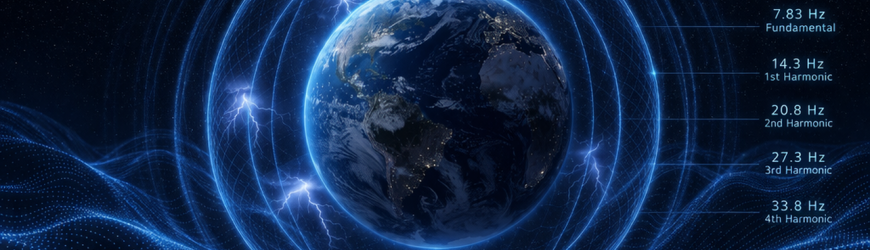
Schumann resonance refers to a set of natural electromagnetic frequencies that occur in the space between the Earth's surface and the ionosphere. This space acts as a large resonant cavity in which electromagnetic waves can travel around the entire planet.
These frequencies are generated mainly by lightning activity in the atmosphere. Thousands of thunderstorms occur every day, producing electromagnetic impulses that circulate around the Earth and create a relatively stable frequency spectrum.
Basic Schumann resonance frequencies
The most commonly cited Schumann resonance values are:
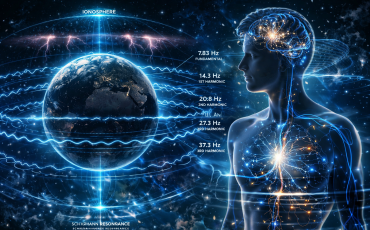
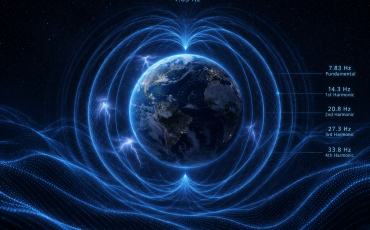
- 7.83 Hz – fundamental frequency
- 14.3 Hz – first harmonic
- 20.8 Hz – second harmonic
- 27.3 Hz – third harmonic
- 33.8 Hz – fourth harmonic
These values may vary slightly depending on atmospheric conditions, solar activity and thunderstorm intensity.
How Schumann resonance is created
From a physical perspective, the space between Earth and the ionosphere behaves like a closed electromagnetic system. When lightning occurs, it produces an electromagnetic wave that can propagate around the planet. At certain frequencies, resonance occurs, meaning the wave is amplified.
This phenomenon was described in 1952 by physicist Winfried Otto Schumann.
The human organism as a bioelectrical system
The human body operates using electrical impulses. The nervous system transmits signals through changes in electrical potential. The brain generates measurable brain waves that occur within specific frequency ranges.
- Delta waves: 0.5 – 4 Hz
- Theta waves: 4 – 8 Hz
- Alpha waves: 8 – 12 Hz
- Beta waves: 12 – 30 Hz
- Gamma waves: 30+ Hz
Interestingly, the fundamental Schumann resonance frequency of 7.83 Hz lies near the range of theta and alpha brain waves, which are commonly associated with relaxation and meditation.
Why Schumann resonance is interesting for meditation
States of deep relaxation and meditation are often associated with slower brain wave activity. Some research suggests that stable natural rhythms may support psychological balance.
However, it is important to note that the influence of Schumann resonance on the human body remains an area of ongoing research.
Natural environment and electromagnetic stability
Modern humans spend much of their time in environments with high levels of artificial electromagnetic signals. Returning to nature may provide exposure to natural environmental rhythms, including light, sound and electromagnetic processes.
Meditation, time spent in nature and working with minerals may support concentration and awareness of the present moment.
Schumann resonance, vibration and minerals
Minerals have stable crystal structures and specific physical properties. In combination with meditation, they may help create an environment that supports focus, calmness and attention.
Crystals can serve as a physical element that helps direct attention and stabilise the meditation process.
Conclusion
Schumann resonance is a fascinating natural phenomenon demonstrating that the Earth is not only solid matter but also a dynamic electromagnetic system. The human organism functions as a bioelectrical structure sensitive to environment, rhythm and natural processes.
Exploring these relationships connects physics, biology and neuroscience with a deeper understanding of natural systems.
Recommended minerals for meditation and balance
- Clear quartz – pure structure and universal use
- Amethyst – calmness and focus
- Labradorite – optical depth and structure
- Obsidian – strong visual character
Frequently asked questions
What is Schumann resonance?
It is a set of natural electromagnetic frequencies occurring between Earth's surface and the ionosphere.
What is the Earth's fundamental frequency?
The most commonly cited value is 7.83 Hz.
Is Schumann resonance related to meditation?
Some research suggests possible connections with brainwave frequencies present during relaxation.
Which minerals are used during meditation?
Clear quartz, amethyst and rose quartz are commonly used.