Investment Gemstones: Tanzanite, Sapphire, Padparadscha Sapphire and Emerald | MINERALS-STONES®

Investment Gemstones: Tanzanite, Sapphire, Emerald and Rare Colored Gemstones
Investment gemstones are becoming increasingly important among collectors, investors and lovers of natural gemstones. Today, interest is no longer focused only on diamonds, but increasingly also on rare colored gemstones with natural origin, limited availability, strong color and professional certification.
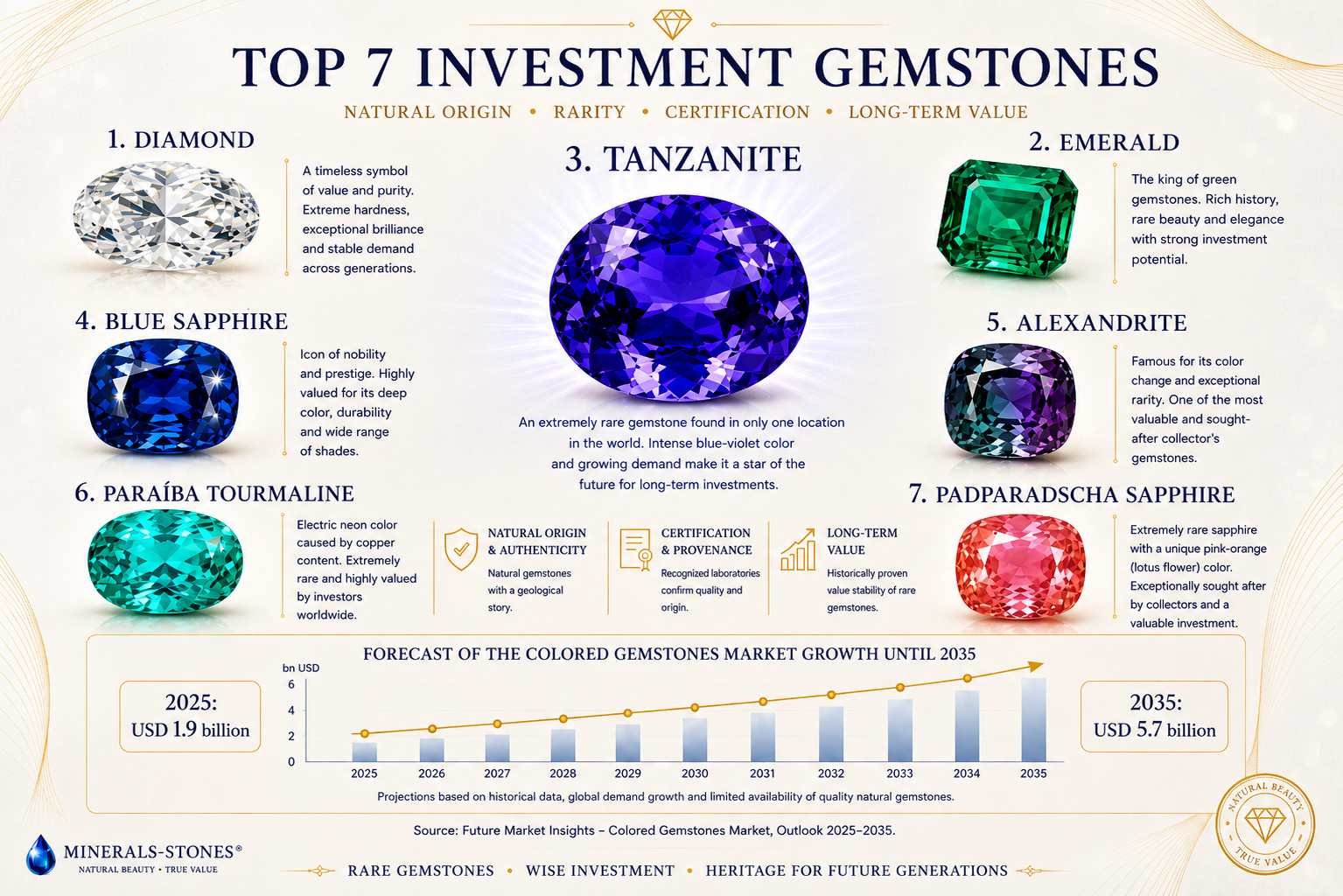
Among the most interesting gemstones from a long-term value perspective are tanzanite, blue sapphire, Padparadscha sapphire, emerald, alexandrite, ruby, spinel, Paraíba tourmaline and selected natural diamonds of higher quality. Each of these stones has its own story, origin and evaluation criteria.
Why are investment gemstones such a relevant topic today?
Interest in investment gemstones has grown significantly in recent years. More and more collectors, investors and lovers of luxury jewelry are focusing not only on classic diamonds, but also on rare colored gemstones with natural origin, limited availability and clearly documented quality. This category includes tanzanite, sapphires, emeralds, alexandrites, rubies, spinels and Paraíba tourmalines.
According to a market report by Future Market Insights, the global colored gemstone market is expected to grow from approximately USD 1.9 billion in 2025 to USD 5.7 billion by 2035. This development shows that colored gemstones are no longer only part of the jewelry segment, but are increasingly seen as an area of collector and investment interest.
A similar trend is described by the professional portal Rapaport, which highlights the growing demand for high-quality natural stones with minimal treatments in its overview of gemstone market trends. Special attention is given, for example, to no-heat sapphires and rubies, no-oil emeralds, untreated spinels, tsavorites and other rare colored gemstones.
For investors, it is important to understand that gemstone value is not based only on beauty. The decisive factor is the combination of several elements: natural origin, rarity, color, clarity, size, cut, certification, documented origin and long-term demand. This is why gemstones with not only aesthetic value, but also a strong geological story and limited availability, are increasingly coming to the forefront.
What determines the investment value of a gemstone?
The investment value of a gemstone is not determined by its name alone. It is not enough to say that a stone is a diamond, sapphire, emerald or tanzanite. The decisive factor is always the specific quality of the individual stone.
For colored gemstones, color is usually the most important factor. Saturation, tone, evenness and overall visual appeal all matter. A large stone with weak color may have a lower value than a smaller but exceptionally high-quality specimen.
Other key factors include clarity, cut quality and origin. For certain gemstones, locality can significantly influence price. Colombian emeralds, Burmese rubies, Kashmir sapphires, Sri Lankan Padparadscha sapphires or tanzanites from the Merelani Hills carry strong historical and collector significance.
| Criterion | Importance for value |
|---|---|
| Color | The most important factor for most colored gemstones. |
| Clarity | Affects transparency, brilliance and overall appearance. |
| Cut | Determines light performance, proportions and optical beauty. |
| Size | Larger high-quality stones are significantly rarer. |
| Origin | For important localities, origin can strongly increase collector value. |
| Treatments | Untreated or minimally treated stones are usually more valuable. |
| Certification | Increases credibility and makes future resale easier. |
Tanzanite: the gemstone of a single locality
Tanzanite is one of the most fascinating colored gemstones of the modern era. Commercially, it is mined in only one region of the world – the Merelani Hills in northern Tanzania. This geographic uniqueness, together with its blue-violet color and strong pleochroism, makes it an exceptionally attractive stone for collectors and long-term investors.
From an investment perspective, the most interesting tanzanites are high-quality stones with deep blue-violet color, higher clarity, larger carat weight and ideally professional certification. Not every tanzanite is automatically an investment stone – the specific quality, appearance, size and documented origin are always decisive.
Sapphire and Padparadscha sapphire
Sapphire is one of the most important gemstones in the world. It belongs to the corundum group and reaches a hardness of 9 on the Mohs scale. This makes it suitable not only for collections, but also for luxury jewelry worn every day.
From an investment perspective, high-quality natural sapphires without heat treatment, known as no-heat sapphires, are especially interesting. Origin also plays an important role, particularly Sri Lanka, Myanmar, Kashmir and Madagascar. For blue sapphires, depth and purity of blue color, evenness, transparency and certification are decisive.
A very special category is the Padparadscha sapphire. This extremely rare sapphire shows a delicate combination of pink, orange and salmon tones. Its name is traditionally associated with the color of the lotus flower. High-quality Padparadscha sapphires are among the rarest colored sapphires and are highly valued by collectors and investors.
Emerald: royal green classic
Emerald is one of the most historically prestigious gemstones. The best-known emeralds come from Colombia, especially from the regions of Muzo, Chivor and Coscuez. High-quality emeralds from Zambia are also highly valued, often offering deep green color and good transparency.
With emeralds, it is important to carefully monitor the degree of treatment. Oil treatment is common and is used to improve the appearance of the stone. From an investment perspective, stones with minimal treatment or so-called no-oil emeralds are especially interesting, ideally with a certificate from a respected gemological laboratory.
Alexandrite, ruby, spinel and Paraíba tourmaline
Alexandrite is an exceptionally rare gemstone known for its color change depending on the type of light. High-quality natural alexandrites with a strong color-change effect are highly sought after.
Ruby is the red variety of corundum and belongs to the most historically valuable gemstones. The most highly valued rubies are high-quality natural stones with vivid red color, ideally without heat treatment.
Spinel was underestimated for a long time because it was often mistaken for ruby in the past. Today, its prestige is increasing significantly, especially for high-quality untreated red, pink or cobalt-blue stones.
Paraíba tourmaline is one of the most striking modern gemstones. It is valued for its neon blue to green-blue color caused by copper. Truly high-quality Paraíba tourmalines are very rare and require professional laboratory verification.
Certification as the foundation of a safe purchase
For higher-value investment gemstones, certification should be standard. A certificate helps verify whether the stone is natural, whether it has been treated, what parameters it has and, in some cases, what its geographic origin is.
Recognized laboratories include GIA, IGI, Gübelin Gem Lab, SSEF, AGL and the Czech Gemological Laboratory.
How to buy investment gemstones safely
- choose only natural gemstones with a clear description,
- require certification for higher-value stones,
- do not focus only on carat weight, but on overall quality,
- check color, clarity, cut, origin and treatments,
- avoid suspiciously cheap offers,
- buy from specialized professional dealers,
- expect a long-term investment horizon.
Frequently asked questions
Are gemstones suitable as an investment?
Gemstones can be an interesting long-term alternative asset if they are high-quality natural stones with clear origin, certification and stable demand. However, they are not a guaranteed investment.
Which gemstones are the most interesting from an investment perspective?
Frequently followed gemstones include tanzanite, sapphire, Padparadscha sapphire, emerald, alexandrite, ruby, spinel, Paraíba tourmaline and selected natural diamonds.
Why is Padparadscha sapphire so rare?
Padparadscha sapphire is rare because of its unique pink-orange to salmon color. High-quality natural pieces with attractive color and certification belong among the most valuable colored sapphires.
Is tanzanite an investment gemstone?
High-quality tanzanite can be interesting from an investment perspective due to its only known commercial deposit, limited availability and growing collector interest. However, the quality of the specific stone is decisive.
Is certification necessary?
For higher-value gemstones, yes. Certification significantly increases credibility and makes future resale easier.
Conclusion: Investment gemstones are not only beautiful stones. They are natural originals with geological history, limited availability and collector significance. The most meaningful choices are high-quality natural stones with clear origin, professional description, certification and a long-term perspective.
Source materials: Future Market Insights – Coloured Gemstone Market Size, Market Forecast and Outlook Rapaport – Gemstone Trends in 2025 GIA – Gemological Institute of America SSEF – Swiss Gemmological Institute Gübelin Gem Lab
https://minerals-stones.com/en/13-investment-gemstones-natural-cut-stones