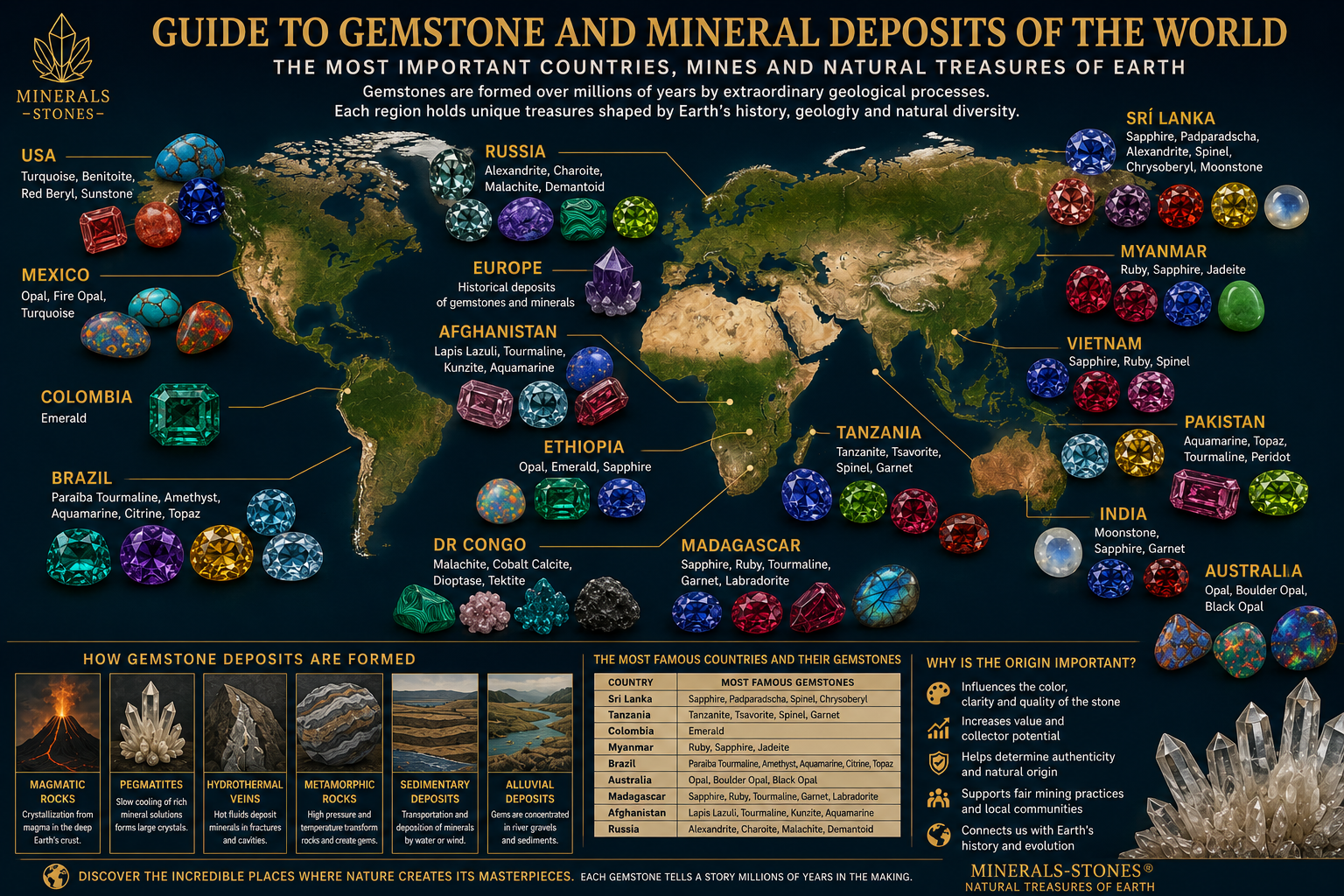
Guide to Gemstone and Mineral Deposits of the World | MINERALS-STONES

Guide to Gemstone and Mineral Deposits of the World: The Most Important Countries, Mines and Natural Treasures of Earth
Gemstones and minerals are not distributed randomly across the world. Every sapphire from Sri Lanka, emerald from Colombia, tanzanite from Tanzania, opal from Australia or ruby from Myanmar is the result of very specific geological processes that took place over millions to billions of years. The combination of rock chemistry, pressure, temperature, tectonic movements, volcanic activity and later erosion determines where the most important gemstone deposits on Earth are formed.
This MINERALS-STONES® guide is the introduction to an extensive mineralogical atlas of the world. Its purpose is to explain why certain countries are famous for specific gemstones, how deposits form, how primary and secondary deposits differ and why the origin of a stone is essential for its value, collector appeal and future investment potential.
Why gemstone origin matters so much
The origin of a gemstone is not just a geographic detail. For high-quality minerals and gemstones, locality is one of the key parameters that can significantly influence price, rarity and credibility. A sapphire from Sri Lanka, ruby from Mogok, emerald from Muzo or tanzanite from Merelani Hills is not just a trade description. These names carry specific historical, geological and market value in gemology and collecting.
Some localities are known for exceptional color, others for clarity, crystal size or rare optical effects. Sri Lanka, for example, is famous for sapphires, padparadscha sapphires, alexandrites, spinels and chrysoberyls. Tanzania is the only source of tanzanite in the world. Colombia is the iconic country of emeralds, and Australia has become the global symbol of opals.
How gemstone deposits form
Gemstone deposits form through different geological processes. Some gemstones crystallize deep within Earth’s crust under high pressure and temperature. Others grow inside fractures in rocks, where minerals crystallize from hot chemical-rich fluids. Others are gradually released from the parent rock by erosion and accumulate in river sediments.
The presence of the right chemical elements alone is not enough to create a gemstone. Suitable physical conditions, enough time, space for crystal growth and later geological processes that preserve or transport the stone to places where it can be found are also essential.
Why some countries have so many gemstones
Some countries are located in exceptionally favorable geological regions. Sri Lanka is a typical example, consisting of ancient metamorphic rocks rich in corundum, spinel, garnet and chrysoberyl. Brazil has extensive pegmatite regions that produce tourmalines, aquamarines, topazes, amethysts and quartz crystals. Madagascar is a geologically diverse island with deposits of sapphires, rubies, tourmalines, labradorites and garnets.
A large number of gemstones in one country is therefore not a coincidence. It occurs where suitable rocks, tectonics, metamorphism, magmatic activity and erosion have combined during Earth’s history. This is why some countries are true mineralogical powers.
Magmatic rocks and gemstones
Magmatic rocks form by the solidification of magma. During this process, minerals containing rare elements may crystallize and form crystals suitable for collecting or jewelry. Some gemstones are linked to specific magmatic environments, such as peridot in basalts or certain types of garnets in deep-seated rocks.
Magmatic activity is also important because it can bring minerals from deeper parts of the Earth closer to the surface. In some cases, volcanic or plutonic processes make it possible for gemstones to reach environments where they are later exposed by erosion.
Pegmatites: treasure chambers of large crystals
Pegmatites are among the most important rock environments for the formation of large and aesthetic crystals. They are coarse-grained magmatic rocks that form from the final remnants of magmatic fluids rich in water, volatile components and rare elements. Slow cooling and high concentrations of chemical elements allow exceptionally large crystals to grow.
Pegmatites are significant sources of tourmalines, aquamarines, kunzites, topazes, beryls, quartz crystals and other collector minerals. Brazil, Afghanistan, Pakistan, Madagascar and some regions of the United States are among the best-known pegmatite areas in the world.
Hydrothermal veins
Hydrothermal veins form when hot mineral-rich fluids move through fractures in rocks and gradually deposit crystals. This process is extremely important for the formation of quartz, amethyst, fluorite, barite, calcite, sulfide minerals and in some cases gemstone varieties.
Hydrothermal environments are typical of areas with tectonic activity, magmatism or old fracture systems. Crystals from hydrothermal veins often show aesthetic growth, well-developed crystal faces and high collector value.
Metamorphic rocks and the formation of rare gemstones
Metamorphism is the process by which rocks are transformed under high pressure and temperature. Metamorphic rocks are especially important for the formation of many of the world’s most valuable gemstones. Corundum, the mineral that forms sapphire and ruby, often forms in aluminum-rich metamorphic rocks.
Metamorphic environments are also important for the formation of spinel, garnet, chrysoberyl, alexandrite and some types of emeralds. Countries such as Sri Lanka, Myanmar, Madagascar, Tanzania and Russia are famous precisely because of their ancient metamorphic complexes.
Sedimentary deposits
Sedimentary deposits form by the accumulation of material transported by water, wind or gravity. Some minerals may be released from their original rock by erosion and later concentrated in sediments. This creates deposits that can be economically and scientifically important.
Typical examples of sedimentary environments include some opal deposits or layers rich in heavy mineral grains. Sedimentary environments are also important because they may preserve gemstones released from other rocks.
Alluvial deposits: gemstones in rivers
Alluvial deposits form in river sediments. Gemstones are gradually released from the parent rock, transported by water and concentrated in sands, gravels and river deposits. This type of deposit is very important in Sri Lanka, Myanmar, Madagascar and some regions of Africa.
Alluvial mining is historically one of the oldest ways of obtaining gemstones. People could find sapphires, rubies, spinels or garnets directly in river gravels, often without deep mining. This is how the reputation of many traditional gemstone regions was established.
Primary and secondary deposits
A primary deposit is the place where a mineral formed directly in the parent rock. A secondary deposit forms when the mineral is released from its original location by erosion and transported, for example by water, into river sediments.
The difference between primary and secondary deposits is important for understanding quality, appearance and mining methods. Gemstones from secondary deposits are often naturally rounded, while crystals from primary deposits may preserve their original crystal shapes.
Why this guide matters when choosing a gemstone
A customer who understands gemstone origin can make much better decisions. Origin helps explain why one stone has a higher price, why a certain color is rare, why some localities are prestigious and why certification, origin and professional description matter when choosing high-quality gemstones.
At MINERALS-STONES® we place long-term emphasis not only on the beauty of stones, but also on their origin, quality, authenticity and expert context. This guide will gradually expand into individual countries, deposits, famous mines, typical gemstones and related articles focused on specific localities.
Overview of the main types of gemstone deposits
| Type of deposit | How it forms | Typical gemstones and minerals |
|---|---|---|
| Magmatic rocks | By solidification of magma and crystallization of minerals | Peridot, certain garnets, zircon |
| Pegmatites | By slow cooling of fluids rich in rare elements | Tourmaline, aquamarine, kunzite, topaz, quartz crystal |
| Hydrothermal veins | By deposition of minerals from hot fluids in rock fractures | Quartz, amethyst, fluorite, calcite, barite |
| Metamorphic rocks | By transformation of rocks under high pressure and temperature | Sapphire, ruby, spinel, garnet, chrysoberyl |
| Sedimentary deposits | By accumulation of mineral material in sediments | Opal, some heavy minerals |
| Alluvial deposits | By concentration of gemstones in river deposits | Sapphire, ruby, spinel, garnet, diamond |
Conclusion of the first part: Gemstones are the result of Earth’s long geological history. To understand their value, knowing only the name of the stone is not enough. It is essential to understand its origin, deposit type, geological environment and historical importance of the locality. This is why the guide will continue with individual countries and their most important natural treasures.
Links to other educational blog articles Minerals-stones:
https://minerals-stones.com/en/blog/